 Skip to content

A Wedding is more than just a day of Celebration, It is the Day where ‘Two Hearts’ promise to begin their journey together…
Every detail can carry a Part of that Journey, from flowers chosen by a loved one to the setting where the couple takes their Vows. Decoration gives these moments a place to come together and be remembered.
But what makes a wedding setting look complete rather than simply filled with beautiful things? Often, it is the way each element is placed beside, behind or in front of another. This is the ‘Art of Layering’. For the Best Wedding Decorators in Kongu Region, it is not about adding more, it is about knowing what should stand forward and what should support it.
Let’s follow this idea from grand installations to the smallest bloom, and see how each choice helps shape a celebration that stays in the hearts of those who share it.
The Rhythm of Repetition
Layering is an Art, where every element put together, blended seamlessly allowing them to complement each other, with layers repeating to create a visual harmony where a beautiful rhythm flows.
A Shape, Colour, Pattern or Material appears in more than one place, helping different parts of the wedding setting feel connected. This does not mean copying the same arrangement everywhere. It means carrying a detail from one part of the design into another.
A curved frame at the entrance, for example, may be Echoed in the mandap or backdrop panels. A floral colour used at the entrance may return in the Stage Decoration and table arrangements. These links create a shared design language as guests move through the Wedding Venue.
A row of lamps, panels or flowers placed at measured intervals can guide the eye along a pathway. Professional Wedding Decorators use this rhythm to connect areas without making every arrangement identical.
☰ Layers: Pattern / Connection / Continuity
The Grandeur of Graceful Installations
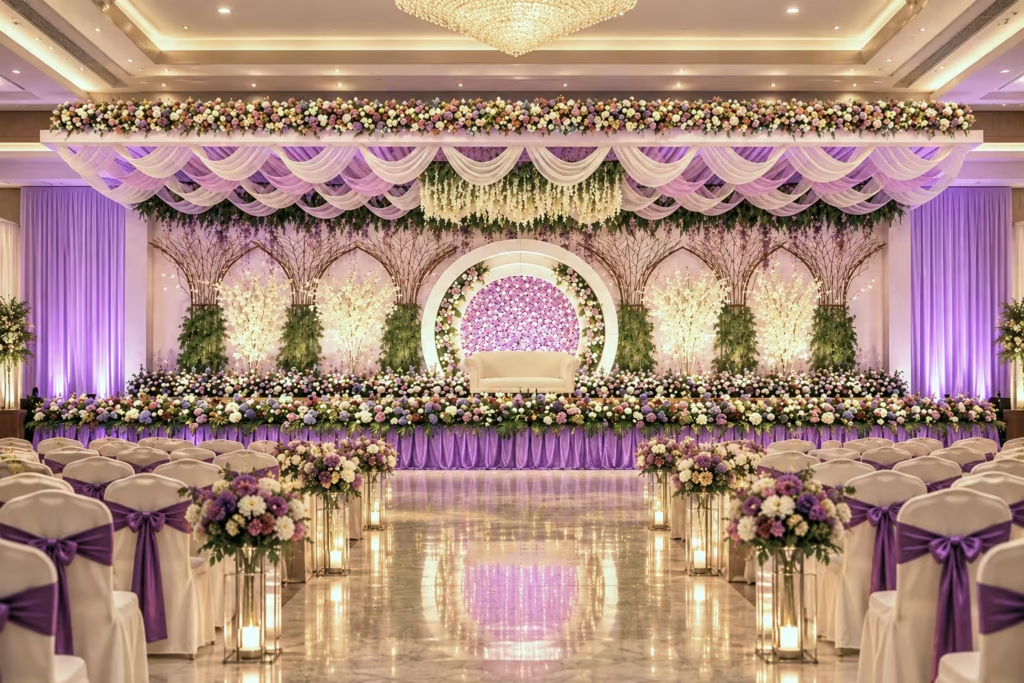
Large-scale layering is easy to notice in the main structures of a wedding. An entrance may combine a frame, panels, fabric, flowers and lighting.
Each has a role: The Frame gives shape, Panels form the background, Flowers add colour and lighting brings out key details.
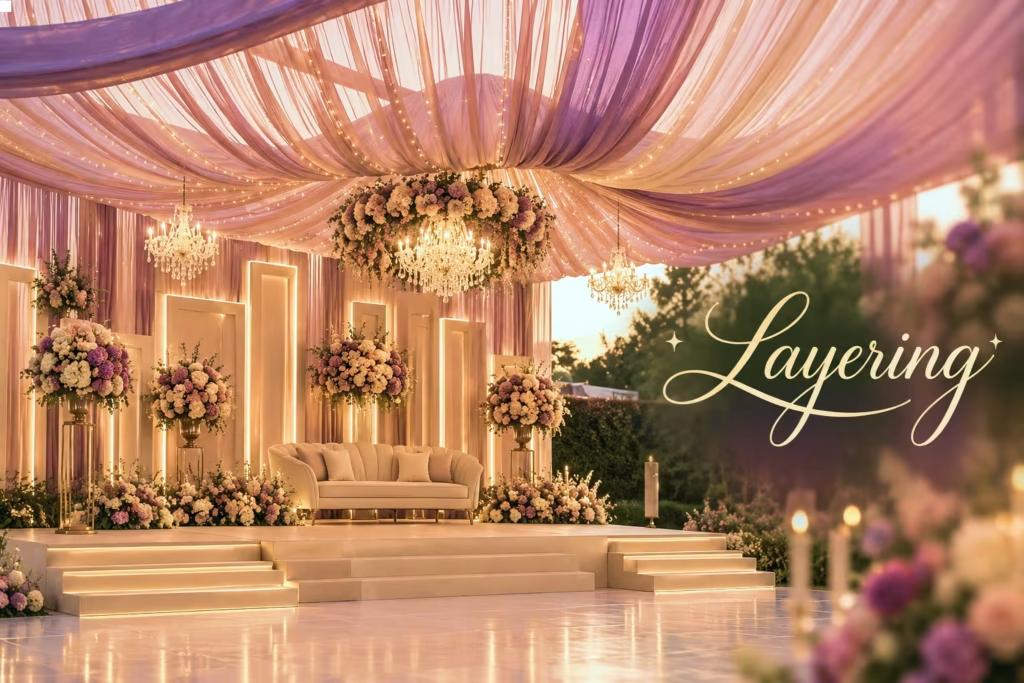
The same approach works on a stage or mandap. Instead of one flat backdrop, two or more panels can sit at different distances. A front panel may carry a floral feature, while a quieter panel behind it adds scale. A canopy can create another level above the stage, with hanging flowers or lights linking it to the structure below.
The Hall Decoration matters too. A detailed stage may need quieter walls, while simple Wall Decor can help connect the hall with the overall theme. A high Ceiling decoration can also make room for suspended elements. The design should respond to the venue rather than force the same layout into every setting.
For the Best Wedding Decorators in Kongu Region this balance matters in Traditional and Contemporary designs. A mandap can retain Magnificent forms while its panels, finish or lighting give it a fresh look. The ceremony remains at the heart of the design.
☰ Layers: Structure / Scale / Dimension
The Beauty of Blooming Layers

Small-scale layering can be seen in a garland, bouquet or Flower Arrangement.
Every flower has its own place in wedding decoration. But placement alone cannot create a floral arrangement, it takes an understanding on its proportion and form of each blooms, this involves a technique called ‘Layering’.
The Art of Layering lies in bringing these flowers together at different levels.
A floral installation may begin with a base of foliage, followed by fuller blooms and delicate flowers placed between them. Long jasmine strings can fall around a floral backdrop, while shorter garlands sit closer to its frame.
Hanging flowers, trailing vines and clustered blooms can also be combined to create different layers. A Bouquet follows the same principle on a smaller scale, with each bloom finding its place.
Personalisation adds another touch. A family may prefer flowers linked to a tradition, while the couple may want a softer colour palette or a Contemporary finish. Each bloom should Contribute, not Compete.
☰ Layers: Focal / Filler / Foliage
The Flow of Fabric and Form

Fabric brings movement to Wedding Decor.
It can soften a Rigid frame, elevate a backdrop or turn a simple canopy into a Graceful installation. The way it is arranged also changes the character of the design.
Curtain decoration adds elegance to the setting, with neat folds creating a smooth, flawless look…
At an entrance, flowing drapes can frame the pathway, while gathered fabric can create a fuller appearance around a stage. Overlapping panels add variation to a backdrop, and carefully placed folds can highlight the shape of a venue. Each technique gives fabric a different role within the composition.
“Where Structure gives form, fabric gives it movement. Together, they create a beauty that feels effortless”.
The choice of fabric matters too. Sheer textiles allow light to pass through, while heavier fabrics create fuller folds and stronger visual coverage.
Through Customisation, these choices can reflect the couple’s preferences and complement the overall Wedding Decoration, whether they favour soft, flowing drapes or structured arrangements with defined folds. When every fabric choice works together, even the simplest Draping can become a memorable part of the celebration.
☰ Layers: Cascade / Drapey / Finesse
Contemporary, Contrasts and Compositions
Contemporary wedding design moves beyond matching arrangements and uniform layouts. Techniques such as asymmetry, tonal layering and mixed materials offer new ways to bring decorative elements together.
An asymmetrical Backdrop Decoration uses different heights and shapes on each side. This creates a design that does not look the same on both sides. Tonal layering uses different shades of one colour across flowers, fabrics and panels. Mixing materials such as wood, metal and acrylic adds contrast.
Each material brings a different look, from natural finishes to reflective surfaces and structured forms. Each approach creates variation without making the overall design feel disconnected.
These ideas also influence how a Wedding Venue is decorated. A spacious hall may allow larger installations and suspended elements, while a smaller setting may benefit from simpler arrangements.
By balancing Contemporary techniques with the couple’s preferences and wedding traditions, Wedding Decorators can create a setting where the Decor feels fresh while keeping its Original Charm.
☰ Layers: Trend / Experimentation / Expression
The Balance Behind the Beauty
Every element may look beautiful on its own, but the full arrangement needs balance. This does not mean placing the same number of flowers or panels on each side. It means distributing visual weight so one part does not overpower the rest.
A large floral installation on one side may be balanced by a simple frame or lamps on the other. A detailed stage may need a quieter entrance. Bright colours can sit beside neutral fabrics, while reflective materials may need softer surroundings. These choices help the eye move through the setting.
A light behind a panel can reveal its outline, while a focused beam can draw attention to a floral feature. Too much light can flatten the arrangement and hide fine details. A professional decorator can help achieve the right lighting balance and bring out every detail beautifully.
The Best Wedding Decorators in Kongu Region consider how guests see and move through each area. They also plan the decor to suit the available height and connect each area with the next. From Entrance Decoration to Stage Decoration, every area should have its own character while feeling part of the same celebration.
☰ Layers: Proportion / Placement / Harmony
A Little Note
Repeating with purpose → Building with proportion → Mixing materials thoughtfully → Leaving Space to Breathe → Balancing Each Detail
Layering is not about hiding one detail behind another: “It is about giving every detail the right place, so the whole celebration feels deeper, warmer, and more complete”.
